
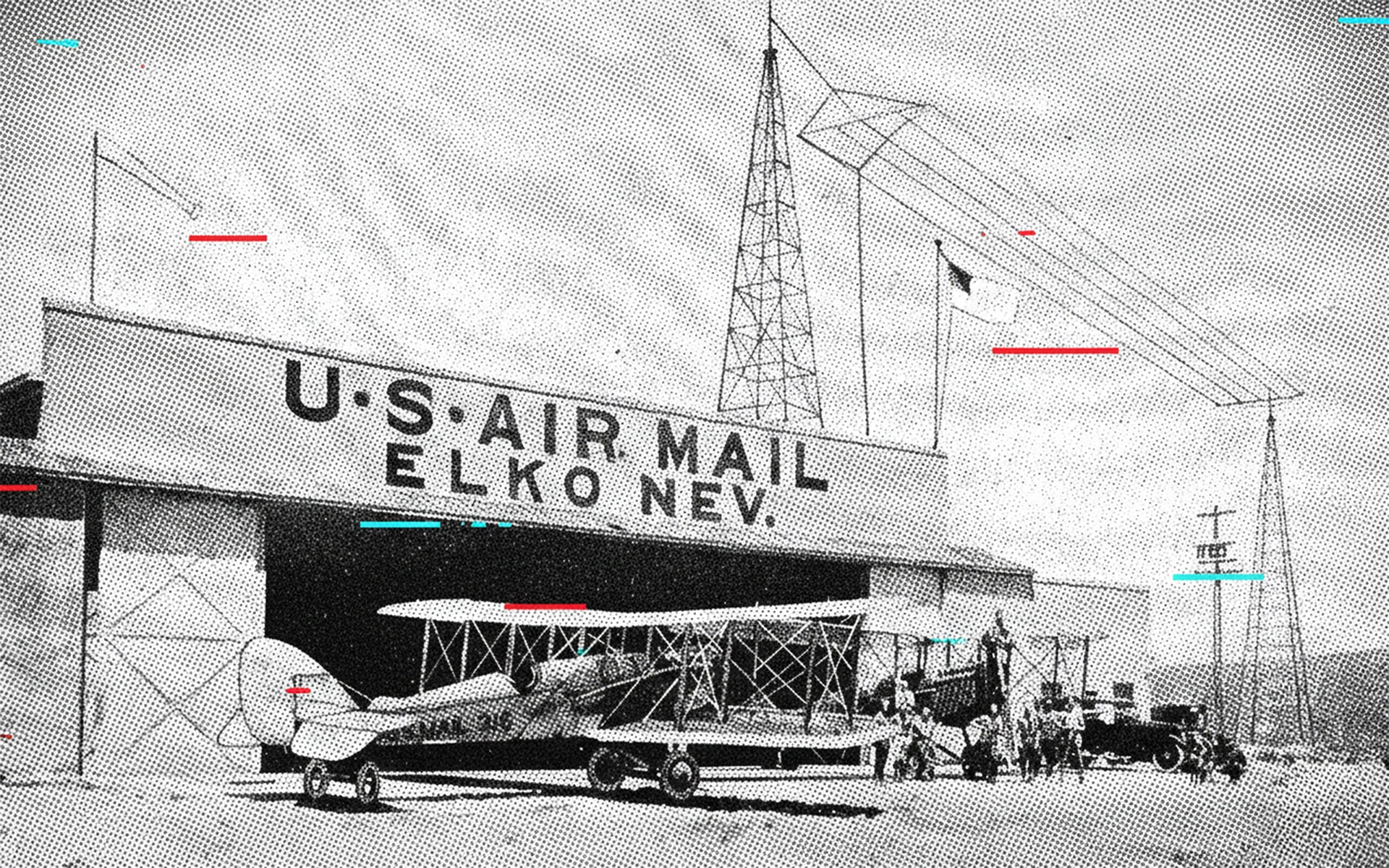
The concrete arrows of the Transcontinental Air Mail Route
In the deserts, plains, and mountain ridges of the American West, there are places where the landscape hides a peculiar secret. Etched into the ground, sometimes barely visible beneath scrub and stone, lie enormous concrete arrows. Some stretch more than 20 metres from tip to tail. Others sit on lonely mesas or ridgelines, far from any road or settlement. To stumble upon one today feels accidental, almost unreal.
These arrows are not monuments, artworks, or military relics. They are the remains of one of the most ambitious navigation systems ever built for aviation. In the 1920s, long before radio navigation or satellites, these arrows formed part of the Transcontinental Air Mail Route, guiding pilots across the United States by sight alone. Together with hundreds of illuminated beacon towers, they helped turn air mail from a risky experiment into a reliable, nationwide service.
Nearly a century later, the arrows remain fixed in place, pointing across landscapes that have changed very little since the biplanes first passed overhead.
When flying needed a path on the ground
The United States Air Mail Service began operations in 1918, at a time when aviation was still finding its footing. Aircraft were fragile, engines unreliable, and navigation rudimentary. Early airmail pilots flew during daylight hours only, following railroads, rivers, and roads to stay oriented. When night fell, the mail went back onto trains.
This limitation quickly became a problem. If air mail was to justify its cost and prove faster than rail transport, it needed to operate continuously, day and night. That requirement pushed pilots into unfamiliar and dangerous territory. Flying at night meant darkness, poor weather, and a near-total lack of visual reference points, especially over the wide-open spaces of the Midwest and West.
A defining moment came in February 1921, during a bold attempt to demonstrate uninterrupted coast-to-coast air mail service. Amid snowstorms and low visibility, pilot Jack Knight took off from North Platte, Nebraska, after dark, guided only by bonfires lit along the route by postal workers and volunteers. His successful overnight flight became national news and made the problem clear. Pilots could fly at night, but they needed help.
The solution would reshape American aviation.
Building a lighted airway across a continent
In 1923, the federal government approved funding for a permanent lighted airway linking the East and West Coasts. The idea was straightforward in concept but massive in scale. A chain of beacon towers would be built across the country, spaced far enough apart that each light could be seen from the next in clear weather. Pilots would fly from beacon to beacon, following a visual path across the night sky.
Construction began in the middle of the country, between Chicago and Cheyenne, ensuring that aircraft departing from either coast could reach the illuminated section by nightfall. From there, the system expanded outward.
Each beacon consisted of a steel tower roughly 15 metres tall, topped with a powerful rotating light. The beacon flashed continuously, visible for up to 60 kilometres on clear nights. At many sites, additional directional lights pointed along the airway, marking the exact course to follow.
The system included more than just lights. Emergency landing fields were placed at regular intervals, and airfields along the route were upgraded with floodlighting and fuel facilities. By July 1924, pilots could fly the entire New York to San Francisco route overnight, cutting days off delivery times.
The results were immediate. Mail that once took nearly a week to cross the country could now arrive in little more than 30 hours. The Transcontinental Air Mail Route had proven that long-distance aviation was not only possible, but practical.
Why arrows were poured into the earth
While beacon towers solved the problem of night navigation, daytime flying remained challenging. Pilots still relied heavily on visual cues, and in many regions those cues were unreliable or nonexistent. Over deserts, plains, and high plateaus, it was easy to drift off course without realising it.
To address this, the Department of Commerce introduced an additional layer of guidance. At many beacon sites, workers poured massive concrete arrows directly onto the ground, aligned with the direction of the airway. Painted bright yellow, these arrows were meant to be seen from the air during daylight hours.
Each arrow pointed toward the next beacon along the route. East–west airways used arrows that pointed east, while north–south routes used arrows pointing north. This consistency helped pilots quickly interpret what they were seeing from above.
The arrows were large by necessity. Most measured between 15 and 21 metres in length, with broad triangular heads and long tapered tails. Many were built on raised ground or ridgelines to improve visibility. At the base of the arrow, a small generator shed often housed the equipment that powered the beacon tower above. The shed roofs were sometimes marked with route identifiers or beacon numbers, visible from the air.
In an era without radios, moving maps, or electronic displays, these arrows were a simple but effective solution. They did not replace pilot skill or judgement, but they provided reassurance and confirmation in a time when being lost could quickly become fatal.
A nationwide system takes shape
By the late 1920s, the original transcontinental route had become the backbone of a rapidly expanding network. The Air Mail Act of 1925 shifted mail operations to private contractors, accelerating the growth of commercial aviation. Airlines took over mail routes, and the government focused on building and maintaining the navigation infrastructure.
Beacon routes spread in all directions, linking major cities and regional hubs. By the early 1930s, the United States had more than 18,000 miles of lighted airways supported by approximately 1,500 beacons. Concrete arrows accompanied many of these installations, particularly in remote areas.
Some routes were surveyed by figures who would later become aviation legends. Charles Lindbergh, before his transatlantic fame, helped chart air mail routes across the Southwest. The paths he surveyed were soon marked with towers and arrows, turning rough air corridors into organised aerial highways.
The beacon-and-arrow system became a model admired internationally. Other countries adopted similar approaches, building their own illuminated airways inspired by the American example.
The quiet disappearance of the arrows
Despite its success, the visual navigation system was already facing obsolescence by the early 1930s. Advances in radio technology offered new ways to guide aircraft regardless of visibility. Radio ranges and broadcast beacons allowed pilots to fly on instruments, opening the door to true all-weather operations.
As radio navigation improved, the need for ground-based visual markers declined. Maintaining thousands of beacon sites was expensive, and many were gradually decommissioned. During the Second World War, concerns about national security accelerated the process. Beacon towers were dismantled or disabled to prevent potential use by enemy aircraft, and many metal components were salvaged for the war effort.
The concrete arrows, however, were a different matter. Removing them required significant effort, and in many remote locations there was little incentive to do so. Over time, they were simply abandoned.
By the post-war era, most pilots no longer knew they existed.
Rediscovery in the modern age
For decades, the arrows lay unnoticed, fading into the landscape. Some were partially buried by sand or overgrown with vegetation. Others remained remarkably intact, preserved by dry climates and isolation.
Interest in the arrows revived in the late 20th and early 21st centuries, driven by aviation historians, hikers, and researchers using historical maps and satellite imagery. Online communities began cataloguing surviving arrows, documenting their locations and condition.
Today, dozens of arrows are known to survive, particularly in Nevada, Utah, Arizona, and parts of the Great Plains. Some sit just outside growing cities, while others require hours of hiking or four-wheel-drive travel to reach. A few have been repainted or marked by local volunteers to improve visibility and awareness, though preservation efforts vary widely.
In some locations, interpretive signs or plaques explain their significance. In others, the arrows remain unmarked, known only to those who seek them out.
What the arrows represent
The concrete arrows of the Transcontinental Air Mail Route are more than navigation aids frozen in time. They represent a moment when aviation depended on ingenuity, infrastructure, and courage in equal measure. They reflect an era when the sky was still new territory, and progress required bold, physical solutions.
Each arrow points toward a future that pilots of the 1920s could barely imagine. Today’s aircraft cross the same distances guided by satellites, inertial systems, and digital maps. Yet the paths they follow were first carved by mail pilots flying open-cockpit aircraft, trusting blinking lights and painted arrows to lead the way.
Seen from the ground, the arrows are silent and inert. Seen from the air, they once formed a continuous story, linking coast to coast in a chain of direction and purpose.
Nearly a century later, they remain where they were poured, still pointing, still waiting, and still reminding us how aviation learned to cross a continent by following arrows set into the earth.
